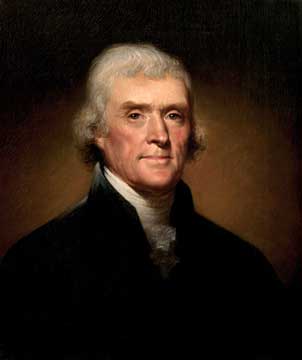
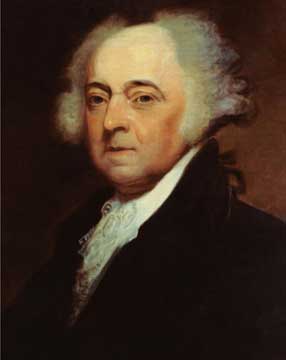
The election campaign of 1800 was a partial replay of the campaign of 1796, with the Jeffersonians opposing Federalist policies. The Alien and Sedition Act somewhat muted the attacks of the Jeffersonians. However, the attacks of the Federalists on the Jeffersonians were not similarly muted. As a result, Federalist newspapers claimed that the election of Jefferson would cause the "teaching of murder robbery, rape, adultery, and incest."
Foreign issues were not as important, as the rise of Napoleon had dampened Jefferson's support for the French. Instead, issues of domestic power and state rights took the spotlight. Jefferson had been one of the authors of the controversial Virginia and Kentucky Resolutions which had declared the Alien and Sedition Act unconstitutional. Although the issue of state nullification of Federal laws would ultimately be settled in favor of the national government, it was a popular issue.
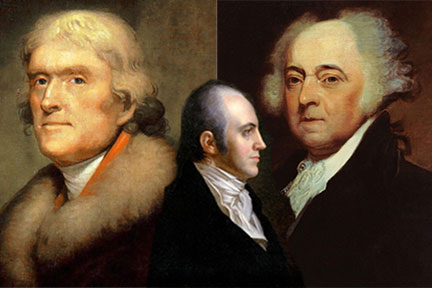
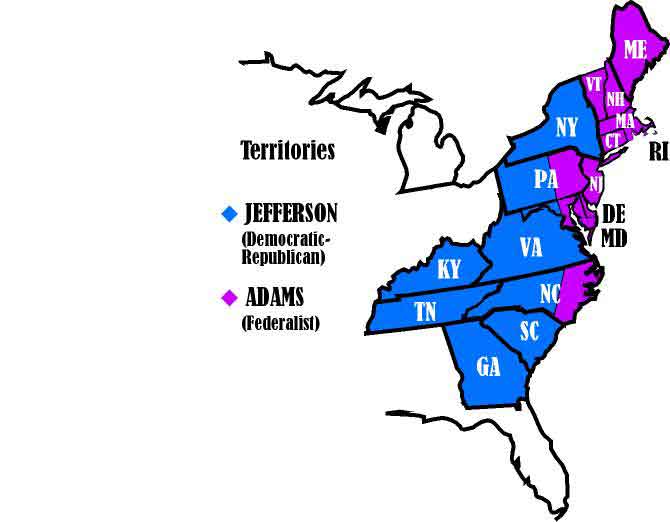
Adams faced substantial opposition within his party. Hamilton opposed Adams reelection and schemed to have Pinckney, Adams Vice Presidential candidate receive more electoral votes and thus become President. The election was settled when the New York legislature became dominated by supporters of Jefferson, thus providing him with 12 critical electoral votes. The defeat to the Federalist, however, did not end the Election of 1800. The Democratic-Republicans made the mistake of assigning the same number of electoral votes to both Jefferson as Burr. Thus no one had the majority of votes, and the election was turned over to the House of Representatives. The House deliberated from February 11th to February 17th and voted 36 times. The Federalist had decided to support Burr, whom many felt was a lesser evil than the "dangerous" Jefferson. They would have won since they were the majority of the outgoing House. However, the constitution called for the election of President by the House to be on a state by state basis, and the Federalist could not carry enough states. On the 36th ballot, Jefferson was selected, but the country had come very close to having Aaron Burr as President.