X-15 Makes Its First Flight
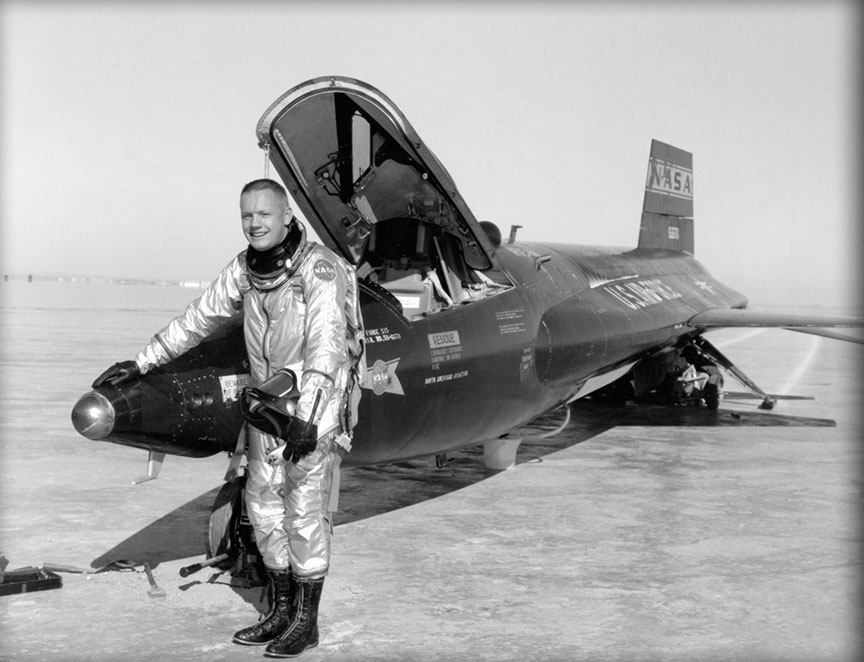
On September 17, 1959, test pilot Scott Crossfield took the North American X-15 rocket-powered research aircraft on its first powered flight after being dropped from the wing of a specially modified Boeing B-52 mother ship over the Mojave Desert above Edwards Air Force Base in California — continuing the tradition of air-launched experimental flight research that had begun with Chuck Yeager's sound barrier flight in the Bell X-1 twelve years earlier on the same desert lake bed.
The X-15 was unlike any aircraft that had preceded it in the history of flight: a sleek black wedge of heat-resistant Inconel-X nickel alloy barely 50 feet long, powered by a single Thiokol XLR99 rocket engine that burned a combination of liquid oxygen and ammonia to produce 57,000 pounds of thrust and could accelerate the aircraft from zero to Mach 6 — six times the speed of sound, or approximately 4,520 miles per hour — in a matter of seconds.
The aircraft had been conceived in the early 1950s as a joint project of NASA, the Air Force, and the Navy to explore the aerodynamic and physiological challenges of hypersonic flight and high-altitude atmospheric reentry, gathering data in a regime of speed and altitude that no wind tunnel or laboratory could replicate and that no existing aircraft could reach. Its airframe had to withstand aerodynamic heating that raised surface temperatures to nearly 1,200 degrees Fahrenheit, requiring materials and thermal protection concepts that had never previously been applied to a piloted aircraft.
Over the course of 199 flights between 1959 and 1968, the X-15 program compiled a research record of extraordinary depth and breadth that fed directly into virtually every subsequent American space program. Eight of the X-15's pilots — including Neil Armstrong, who made seven X-15 flights before being selected as an astronaut — reached altitudes above 50 miles, the boundary at which the United States Air Force awards astronaut wings, making them the first Americans to reach the edge of space before any rocket had carried a human there.
The program's maximum speed of Mach 6.7, achieved by pilot Pete Knight on October 3, 1967, remains to this day the fastest speed ever reached by a crewed powered aircraft under its own power — a record that has stood for nearly six decades. The X-15's research contributions ranged from the practical to the theoretical: its data on hypersonic aerodynamics, reaction control systems for maneuvering above the atmosphere, ablative thermal protection, and pilot physiology at the edge of space provided NASA engineers with the empirical foundation they needed for the Mercury, Gemini, and Apollo programs, and the lifting body configurations explored in X-15 follow-on research contributed directly to the design of the Space Shuttle orbiter.
The black rocket plane that Scott Crossfield first flew over the Mojave on that September morning in 1959 was in every meaningful sense a bridge between the age of aviation and the age of spaceflight — the machine that taught humanity how to fly at the edge of the atmosphere before it had learned to leave it entirely.