Super Constellation Tested
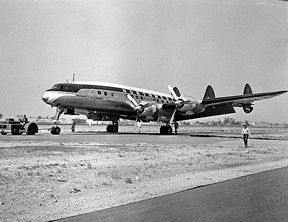
On October 13, 1950, Lockheed unveiled the L-1049 Super Constellation, an extensively stretched and refined development of its celebrated Constellation family that would go on to become one of the most beautiful and capable piston-engine airliners ever built. The original Constellation — the C-69 in its military designation — had itself been a landmark aircraft, conceived by Howard Hughes and TWA in the early 1940s with its distinctive triple-tail configuration and sinuous, dolphin-like fuselage that set it apart visually from every other aircraft in the sky.
The Super Constellation extended the fuselage by eighteen feet, expanding tourist class seating capacity from 69 to 92 passengers while retaining the graceful lines that made the Constellation family so instantly recognizable. Powered by four Wright R-3350 Turbo-Compound radial engines — each developing 3,250 horsepower through an innovative system that recovered exhaust energy to drive additional turbines coupled to the crankshaft — the Super Constellation combined genuine long-range capability with the speed and comfort that the competitive postwar airline market demanded.
TWA, Eastern Airlines, and KLM were among the launch customers who recognized immediately that Lockheed had produced something exceptional. The Super Constellation entered commercial service in 1951 and rapidly established itself as the premier long-range airliner of the early 1950s, capable of flying transcontinental routes nonstop and crossing the Atlantic with a single refueling stop. Its pressurized cabin, relatively low noise levels by piston-engine standards, and generous interior dimensions made it a favorite with passengers, and its distinctive silhouette — that long, graceful fuselage, the three oval tail fins, the four enormous engine nacelles — gave it an aesthetic presence at airports that no subsequent jet airliner has quite matched.
Further developed into the L-1049C, G, and H variants with progressively more powerful engines and greater fuel capacity, the Super Constellation represented the absolute pinnacle of piston-engine airliner development. It served not only the airlines but the United States military in significant numbers, performing long-range patrol, electronic surveillance, and transport duties well into the jet age. Yet its commercial dominance was brief: the introduction of the Boeing 707 and Douglas DC-8 in the late 1950s rendered the Super Constellation obsolete almost overnight, and aircraft that had been the pride of the world's great airlines were retired with startling rapidity.
The Super Constellation's reign at the top of commercial aviation lasted barely a decade, but it was a magnificent decade — the last golden age of the great piston-engine airliner before the jets swept everything before them.